
Welcome
to Our Site Diary
My name is Amna Ola and my Site diary will be focused on a project by KAS Architects for a residential house in Pimlico. With my Partner, Viona Drejta, we will take you through the construction process, provide key information and give you a
better sense of the project from our perspective
"We are two architecture students from the University of Westminster..."


A comprehensive list of all the companies I've contacted
I started contacting the construction site contractors I'd like to work with. I've visited these places and thought them to be a nice site to monitor and took note of the contractor companies that work on the projects which are usually plastered around the site security fence panels. To no avail, we kept emailing companies that we had looked at the considerate constructor's scheme map for more sites to contact. Many didn't respond to our emails and the rest had politely rejected our request.
But after a few more emails sent...
...we got two responses


Since we got two responses we decided to go for KAS Architect's project as we have better contact with the architect himself so we would have a better chance of understanding of shadowing the architect
0
Project summary
PROJECT NAME: 0.1
PIMLICO CONSERVATION AREA HOUSE
SITE ADDRESS: 0.2
57 SUTHERLAND STREET
SW1V 4JY
LONDON
STUDENTS FOLLOWING PROJECT: 0.3
AMNA OLA + VIONA DREJTA
ARCHITECT NAME: 0.4
MIRSAD KRASNIQI / KAS ARCHITECTS
CONTRACTOR NAME: 0.5
NOAR DESIGN AND BUILD
PROJECT CONSTRUCTION VALUE: 0.6
230,000 + VAT
CONSTRUCTION CONTRACT TYPE: 0.7
NOAR DESIGN AND BUILD
START ON SITE DATE: 0.8
JUNE 2024
COMPLETION ON-SITE DATE: 0.9
JANUARY 2025

MAKING SENSE OF THE SITE
The site is located in Pimlico, London.
A family home within a quiet residential area, the site lies under the City of Westminster Council Conservation Area
1
57 SUTHERLAND STREET
SW1V 4JY
LONDON


PURPOSE
1.01
The property is comprised of a lower ground floor, ground and first floor. There is a lightwell to the front of the building and a courtyard to the rear on the lower ground floor level. The purpose of the renovation is to provide more space inside the structure by extending the basement level and providing efficient circulation by rearranging the existing unit layout.
New additions to the extension include:
- Existing vaults extended to create office and study room
- Fireplace removed
- Existing Kitchen space converted to third bedroom from LGF to GF
- Rear courtyard opening increased to allow for new sliding doors.
- Stair to first floor reconfigured.
How did the project originate?
The house is described as a ‘townscape gap’ as designed and built by Thomas Cubitt between 1830s and 1870s. There are several examples of these buildings where they are located behind return frontages to the principal Pimlico terraces and were originally just one storey high above ground level. Almost all of this specific type of building have fully infilled front lightwells. They have also been extended and altered over time.


The current owners of the project's residence are Jessica Emsley and Jack Featherby who are freeholders of the property. They wish to create a much-needed dedicated office space, additional bedroom, enlarged living room space on the lower ground floor and utility room
Meet the Clients
1.02
KEY PROJECT
INFORMATION
Local Authority: London Borough of Westminster
Size: 80 m²
Building Control: London Building Control (LBC)
Engineers: GMZ
Fire Engineer: Fire Safety London
PPE: Provided by KAS Architects
What makes the project financially 1.03
viable?
The project is funded privately and the client has sufficient funds to support their home renovation project. The Financial Viability of this project comes from replacing the patio door and windows to save energy costs.
What is the contract value of the project 1.04
and time scale?
The Project has an estimated value of £230,000 excl. VAT.
Planning application approved: September 2023
Start of construction: July 2024
Demolition and rearrangements completed: September 2024
Basement Excavation completed: November 2024
Completion of construction: January 2025
Key Professionals and 1.05
companies
Contractual Relationship 1.06
ARCHITECT :
KAS Architects - Mirsad Krasniqi
MAIN CONTRACTOR :
Noar Design and Build (NDB)
QUANTITY SURVEYOR:
Simon Levy Associates
BUILDING CONTROL:
London Building Control
STRUCTURAL ENGINEERS:
GMZ Consulting
SUBCONTRACTORS:
Maclennan Waterproofing


CLIENT
The contract is a traditional procurement.
CONSULTANT
ARCHITECT
QUANTITY SURVEYOR
CONTRACTOR
SUBCONTRACTORS
Windows
Plumber
Electrician
This route involves separating design from construction where the client first appoints consultants to design the project in detail to often ensure cost control. The contractor is then appointed for the construction of the project on a single-stage competitive basis.
KAS Architects - Mirsad Krasniqi
Architect's appointment 1.07
KAS is a London-based RIBA-registered architecture and design studio dedicated to creating sustainable buildings and places. The practice is committed to the delivery of well-conceived and thoughtfully detailed architecture. His projects cover all scales of development and building types, creating spaces to live, work and learn.
The client appointed KAS architects for their speciality in renovating homes, astounded by his previous works in London. The architect drew up different layouts and proposals for the client and once they were satisfied with the new proposal, plans and sections were drawn and construction began.


What is the Architect's Role on site? 1.08
The architect's role during construction is to oversee and ensure the correct project implementation is being carried out. They work closely with the contractor and project team to address any issues or challenges. The architect visits the site regularly to monitor progress, observe how work is completed and ensure the project is built according to approved structural plans and specifications. Working closely with subcontractors, the architect reviews drawings and responds to contractor requests. The architect relays information to builders to ensure the project is executed with the intent of the design. Mirsad's role on site is effective as he communicates with contractors and clients who have visited the site and is experienced. For this project he tends to visit once every two weeks
Drawings referred to on-site 1.09


The first plan (Lower Ground Floor) indicated the foundation plan where concrete underpinning is required to excavate the lower ground and rearrangements of plumbing routes.
The second plan (right) of the lower ground floor indicates
where demolition and rearrangement take place [marked red]


These drawings of the Ground and first floor indicate the installation of joists to provide load support as the bathroom is cantilevered above the staircase. these are necessary to provide a stable structure.
Once the proposal is finalised and the drawings are completed, all the necessary information is given to the contractor. These documents are shared between all professionals on-site containing up-to-date drawings.
Frequent meetings are held to keep everyone informed of additional readjustments and are used to monitor construction progress. Surprisingly during our tour of the lower ground floor, the architect explained the principle of underpinning by sketching on drywall.


Own CAD model of
existing structure's plan of work
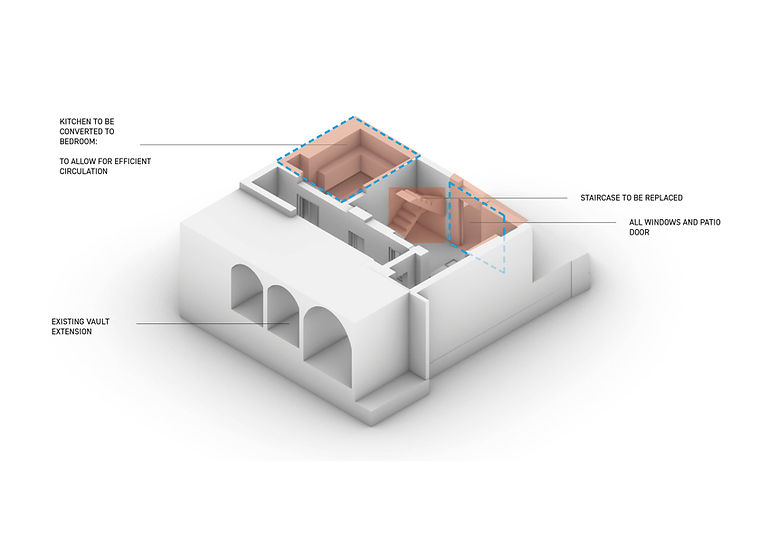


Images of existing building:
These models display the demolition work that is to take place, which includes interior components such as stairs, windows, doors and cavity walls (coloured red) and the new layout (dashed blue). According to the contractor's build programme, the longest amount of time taken to complete was excavating the Lower Ground Floor.
On our first visit, the First floor had been completed and the stairs installed, therefore the Time Lapse Construction Sequence will be focused primarily on changes to the LGF


1. Accessible Existing basement vaults under the public footway
2. Existing staircase layout as seen from the ground floor
3. Unaccessible existing
vault
4. Front lightwell looking towards the partial infill.
The following images depict the existing condition of the property. The proposal will include a full internal refurbishment, change in internal layout and a revised staircase that allows for more efficiently proportioned spaces on the ground floor. The rearrangement of the stairs allows for a generous family dining and kitchen are on the ground floor
There are currently no records of applications on Westminster Borough’s website. There are evidently signs of alterations, such as the basement extension and lightwell infill, but are likely historic applications.

The proposal seeks to excavate and extend existing basement vaults. The proposal also includes the enlargement of an existing lightwell infill. This is considered to be an improvement on the existing partial infill of the lightwell.
There are many examples of the ‘townscape gap’ buildings with full lightwell infills therefore the proposal does not affect the character and appearance of the conservation area. In addition to this, the rear courtyard doors will be enlarged to allow maximum light into the living area. The staircase from ground level to first floor will be redesigned to create a more efficient space on the ground floor. The front lightwell glazing will be opaque in line with other lightwell infills in the Pimlico Conservation area.

This CAD Model was provided by
KAS Architects
The proposal is to convert two existing windows into doors to match the existing windows. This is to allow access to the lightwells.
The area underneath the entrance bridge is proposed to introduce a corridor to allow access from the house to the front vaults. In doing so, the historic fabric of the front cellar vaults will be reintegrated back to the house
Basement development in Westminster SPD (2014)
The following are extracts from the Basement Development in Westminster SPD (Supplementary Planning Document) and why we believe the proposal at 57 Sutherland Street is compatible with the SPD.
6.6.5 "New lightwells to the front of properties are more contentious but may be allowed where they follow a prevailing characteristic or an established pattern within the street. In streets where lightwells do not form part of the local character, applications will be assessed taking into account the characteristics of the street, any existing front garden area and their relationship with the existing building. However, new lightwells set in shallow front garden areas are unlikely to be accepted and will be particularly contentious in mews or similar properties where there is no visual buffer between the front elevation and the street, and lightwells do not form part of local character"
The proposed linking corridor in the front lightwell will maintain the open nature of lightwells on Sutherland Street. The linking corridor will only be underneath the entrance bridge therefore the lightwells will maintain their openness. The front vaults are part of the historic fabric of the building and we think that their excavation and reintroduction to the existing house contributes positively to the history of the building as well as preserving the original architecture.
6.6.3 "Open front lightwells are characteristic features in many streets in Westminster. Where there are existing traditional front lightwells, their further excavation and alteration will not be permitted if this will have a materially harmful visual impact in street views or cause harm to the significance of a listed building."
The proposed linking corridor under the entrance bridge is a prevailing characteristic and an established pattern on Sutherland Street. The proposal therefore is not contrary to 6.6.5 of the Basement Development in Westminster SPD (2014). Most properties on Sutherland Street have developed the spaces underneath the entrance bridges. This is either in the form of a solid infill or a glazed door.


Misaligned windows from
existing infills where the proposal seeks to recreate the vertical alignment of fenestrations on the elevation.
Professionals on-site 1.10
MAIN CONTRACTOR: Agim
ARCHITECT: Mirsad
PROJECT MANAGER

What happens in a site meeting? 1.11
The site meetings gather stakeholders involved in a construction project, including the Architect, Engineers, contractors and clients to discuss progress and challenges by reviewing progress, ensuring quality control and evaluating safety measures. Site meetings are important for communication between all professionals involved.
For this project, the architect visits the site once every two weeks, whereas, the contractor is there daily. He's in charge of conducting the when each stage of construction takes place such as plastering, electrical handling, installation of windows etc. A site meeting is conducted whenever the architect visits and on some occasions the client is also present.
Both the architect and contractor are very proactive, which I think is quite important to make sure work is carried out according to plan.
In some cases, delays occur due to mismanagement where workers aren't time efficient, highlighting the importance of keeping at a certain pace.
Examples where the construction
team may not have worked efficiently 1.13
There have been instances where the instructions to the team for demolishing necessary parts of the walls have not been communicated well. Since there are many unknowns associated with the walls of the cellar vault, measurements on plans and sections had to be altered and this had not been relayed to the team before already starting.
Examples where the construction
team has worked efficiently 1.12
The team has efficiently adapted the glazed windows and patio door at a fast rate, The equipment arrived at the site on time ensuring seamless integration with the existing building as well as waterproofing the facade which was a huge priority. Additionally, excavating the lightwell level to install retaining walls was a difficult process, as well as demolishing the chimney passage on both the ground and first floors. Since the chimney is not being used by the clients, it is appropriate to remove this to create a larger interior space.

Architect
Project Contractor
Client


To initiate the basement excavation, the external lightwell wall is removed to expose both the existing and accessible vault The wall is partially removed to minimise damage to the rest of the brick wall
Time Lapse Construction Drawing
01
02
All contents of the rooms are removed and
Small portions of the lightwell flooring are carefully removed not to damage existing drains. As the proposed lightwell flooring is lowered, excavation takes place by using jackhammers and concrete cutters to remove a depth of approximately 1-meter layers of flooring to install retaining walls for the proposed corridor and sufficient distance for the placement of the first steel beam
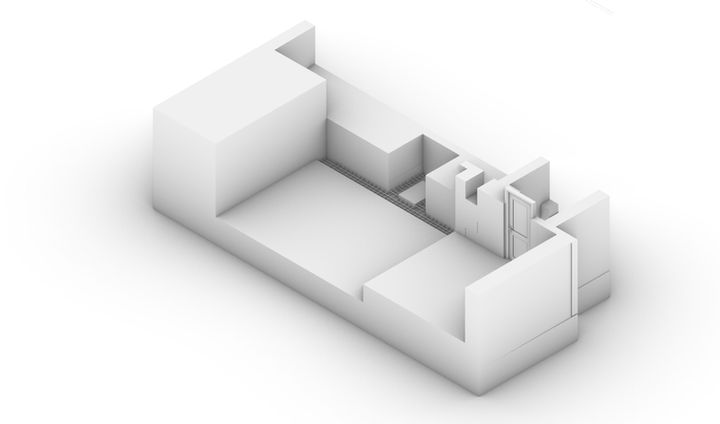
Concrete is poured on-site to create reinforced footing which must be poured first in proportion to its thickness and height. D 98 mesh is wrapped around the steel beam encased with 100mm cover on the sides and 300mm below the beam

03
Vertical rebars are put in place for reinforcement before concrete is poured to create footing, The horizontal and vertical steel beams at low level are arranged and put together


04
After the footing is set, concrete blockwork is put in place for retaining wall to provide additional lateral support
05
The minimum foundation depth is 450mm however it must be confirmed by trial holes. After this is tested, The foundation process begins. Party walls are slowly chiselled to confirm the existing underpin. Rebars are placed in a lattice-like structure (in sections) and the concrete formwork is also installed and cement is mixed


06
After the foundation is set and complete, the lightwell infill is put on the exterior of the house, leaving windows to be put in place in the later stages of the project, The steel beams are painted and covered by plaster that is placed around the beam.

07
Wall infills are placed
THE PROJECT TEAM
3
The Pimlico Conservation Area house aims to achieve net-zero carbon emissions during occupancy. The architect and client have agreed to transform the space by taking the client's best interest into consideration, allowing access and usage of unoccupied interior spaces and efficient circulation during residency. The rooms have been retouched to improve systems for a Flood Risk house.
What is the nature of the agreement between
the Architect and the client? 3.01
Letter of
Proposal
Letter of
Agreement
Letter of
Intent
The nature of the agreement between an architect and a client is outlined in a formal Architect's Appointment Agreement. This sets out the rights, responsibilities, and expectations of the Architect, Client and Contractor if problems occur in a court of law. Both parties are ensured that the professional relationship adheres to legal and ethical standards by reducing miscommunications.
After the contract is signed, the client and architect appoint meetings each week to visit the site and monitor progress to ensure it is to the client's standard
Once the client's wishes are understood, a letter of proposal is sent to the client. it is mainly to communicate to the client your basic understanding of a project and the way you would go about completing the scope of work. If the client is satisfied, a Letter of Intent is sent. This letter offers very minimal legal protection. In it, the architect will restate the terms and scope described in the Letter of Proposal, while expanding the terms and conditions.
Finally, a Letter of agreement is signed. This document provides slightly more legal protection, as it’s signed by both the owner and the architect, It is essentially a more developed Letter of Intent, with the scope described, terms and conditions set forth, and a basic compensation plan developed.
How is the Architect's fee calculated? 3.02
There are 3 ways the architect's fee is calculated
For the case of this project, the Architect's fee is Calculated as a
Lump Sum.
The Architect has done previous projects similar to this where he remodelled the interior of homes in London. Simultaneous to this, KAS Architects is working on an Ambassador's residence
Who is administering the contract? 3.04
Percentage of Construction cost
The percentage is based on the construction costs (excluding VAT), as this can be aligned to the likely time invested by the architect. However, the sum can be unclear if the construction cost fluctuates significantly.
Range:
- Simple projects: 4%–6%
-
Standard projects: 7%–10%
-
Complex projects: 10%–15% or more
The contract administrator is responsible for overseeing the creation, negotiation, and execution of a contract between the employer and the contractor. The CA's role begins when the contract is signed. For this project, Architect Mirsad Krasniqi administers the contract
Time Charge
Projects, where the scope of work is clearly defined, allow the architect to accurately forecast the required time as it gives clients more certainty over costs. However, if significant changes are made to the project, the architect may need to renegotiate their fee.
Lump Sum
Projects with a less well-defined scope, such as feasibility studies assess whether a project is viable. Time charges are flexible and can be particularly effective at the start of the project when there’s little indication of how much work will be involved.
Who are the design team? 3.03
Consultants
Graphic displaying the significance of each role in design
Client
Architect
Main Contractor
Structural Engineeer
The design team consists of multiple individuals who have lent a hand in designing the project. Predominantly it is the architect who has designed plans for the project and is involved in phases 3 and 4 of the RIBA plan of work.
The client establishes the initial design intent and consultants helps the architect take into consideration all necessary aspects associated with the building that effects design 3.04
Has the design team worked efficiently together? 3.05
I think the design team has worked well as they were able to solve challenges associated with the project especially considering there had been many limitations in redesigning the project due to conservation laws resulting in minor disagreements. Either way, the client was satisfied with the result of the project and was completed by the team at a high standard.
The design team consists of multiple individuals who have lent a hand in designing the project. Predominantly it is the architect who has designed plans for the project and is involved in phases 3 and 4 of the RIBA plan of work.
The client establishes the initial design intent and consultants helps the architect take into consideration all necessary aspects associated with the building that effects design 3.04


What is driving the project? 3.06
Programme
Budget
Quality
The driving factor for this project is predominantly quality and budget over a programme where ideally the project should have an equal consideration of all three factors. Mirsad and his team paid immense attention to detail, perfecting each step taken into the project, as the architect has previous experience working on similar home renovation projects, he can assess and quality control during site visits keeping the client's best interest as a main priority. Budgets haven't been cut during the process and any changes remain transparent to the client about the resources the team possess.
Budget: The project is committed to achieving a high-quality outcome where strict management of the construction process will ensure cost control, maintaining the project's financial viability
Programme: Adhering to a set timeline for completion, is achieved by coordinating with the team in hopes of maintaining a consistent pace.
Quality: The project is most dedicated to delivering work to the highest standard. The team is dedicated to their craftsmanship and takes appropriate precautions on site to not damage or ruin the existing structure. It didn't help how I unknowingly touched the door with wet paint!
What are the penalties to the contractor if
the project over runs? 3.07
The contractual relationship between the client and the architect outlines potential delays that could occur, resulting in the project overrunning where liquidated and ascertained damages are common, generally relating to the failure of the contractor to complete the construction works before the date required by the contract. However, they are based on a calculation of damages, and if they are not, or if they are exorbitant, they may be considered a penalty by the courts and therefore may be unenforceable, giving the client an option to pursue a claim. Fortunately for this project, no major delays occurred that convinced the client to proceed with legal action.
Mirsad Krasniqi informs the client remotely in weekly scheduled meetings perchance the project may take longer than expected so that the clients are informed when payments are due
What is the process and procedure for information and 3.08
instructions going to the contractor?
The architect provides the contractor with tender drawings that outline the work to be done, working conditions, and legal rights and obligations. The contractor uses this information to create a quote. Once the drawings are complete, the architect works with the builder to ensure that the specifications are followed. The contractor provides the architect with information about the project's logistics and specifications, such as the square footage and materials needed. This information helps the architect create guidelines for budgeting and other considerations.
How does the design team share and coordinate information? 3.10
The files shared between the team involve a shared Onedrive file where some of the drawings have also been sent to us. This is an effective means of relaying relevant documents where the contractor can provide hard copies of any updated information. These are usually seen scattered around the construction site. Since the project is on a smaller scale, the information is easily shared with members of the team via additional messaging services.


Methods of information sharing:
-
Contractor Schedule
-
In-person/Online meetings
-
Shared OneDrive File
-
Plans and Sections

Are there any Modern Methods of Construction 3.09
being utilised?
Modern Methods of Construction can help speed up the delivery and reduce labour costs. They also eliminate unnecessary waste and Improve quality. For this project, not a lot of modern methods of construction were utilised. The concrete is mixed and poured on-site, any need for prefabrication would have difficulties reaching the Lower Ground Floor of the house.
Identify how digital technology is influencing 3.11
the project?


Digital technology is used as a powerful tool to visualise the building and the changes that are set to take place. Thanks to BIM software, the client is able to produce a model of the proposed building on Revit and make modifications if needed. Visualising the structure helps with measurement calculations in real life by giving an approximate value if to scale and makes it easier for clients to understand the changes proposed as well as help the contractor understand the wishes of the client.
Additional use of technology can be used to survey construction sites such as drones and Internet of Things (IoT) which is a network of sensors and software that can be utilised on construction sites to monitor equipment performance and energy performance
The Architect is responsible for drawing existing and proposed plans of te site. After having submitted these documents and various other essential information to the council, the City of Westminster, it's then pending approval. Planning permission for this project has taken a 12-month delay in getting approved since it is located in a Conservation area. It is not listed but is highlighted as an ‘Unlisted Building of Merit’ in the Pimlico Conservation Area Audit SPG where the client is a freeholder of the property. The project secured planning permissions for an extension to the building, which is unusual for a house in Pimlico. However, there have been multiple instances where additional information is required for this alteration to take place as the house lies under Flood Risk Zone 3.
This process required collaborative discussions and site visits. They were to assess the building's heritage significance and its contribution to the conservation area. It is also required to assess the existing structure with an Environmental Assessment to test whether this building alteration is appropriate.
Additional Documents :
Basement Impact Assessments - A report by a few other consultants, ensuring all the risk have been taken into account from a subterranean perspective, by testing ground conditions and water level heights.
In this case, the planning documents are sent to the Council, then allocated to a planning officer and since it is in a conservation area, it is allocated to a conservation officer too.
STATUTORY APPROVALS
STATUTORY APPROVALS
4
Are the plan drawings on the Planning Portal 4.02
strictly being adhered to?
The drawing on the planning portal offers a different layout for the client, this was when the architect had taken into consideration the client's wishes before any building surveys had taken place
The First-floor bathroom has a different layout since water drain routes need to be considered and the Proposed Lower ground Floor was assumed to use the entire extent of the house's length, however, after these assessments, it is understood that the space is occupied and as a bathroom by the neighbours next door. The assumed space gave access to design an extravagant bathroom for the client that includes a utility room. After running this past the Client, who chose to switch the proposed plans for the bathroom for a study room and vice versa.
Are there any outstanding planning conditions 4.03
still to be discharged?
Currently, there are no outstanding planning conditions left to be discharged


Space assumed to
be unoccupied
Existing Building
First Proposed plans
BUILDING REGULATIONS
How are the building Regulations 4.04
being dealt with?
Building Regulation approval :
The architect needs to demonstrate that the project complies with building regulations.
Various Subsets of building regulations:
- Part M: Accessibility
- Part K: Protection from falling
- Part B: Fire Protection
Demonstrating these components is written in technical drawings.
For small projects, structural engineers are appointed during the building regulation stage after producing technical drawings so that a building control officer can review them, but for larger projects, structural engineers are approached.
The main consultants for this project are:
- The Architect
- Structural Engineer
- Party Wall Surveyor
What is the strategy for inclusive design and access to all? 4.05

inclusive design in architecture is essential for creating spaces that are accessible, usable, and enjoyable for people of all abilities, ages, and backgrounds. It focuses on equity and universal accessibility, ensuring that buildings and environments are not only functional but also promote social inclusion and well-being.
Since this project is set for a private client, inclusive design is not one of their biggest priorities when designing. However, they have been able to provide adequate inclusive designs to the project These include:
-
Stairwell width - 1125mm
-
Door's Width - 762mm
-
Hallway's Width - 1252mm
Are there any Party Wall Issues? 4.07
The architect was concerned with party wall issues since work would have been done on the wall between the adjoining neighbour. Party wall agreements had taken a while to get approved since some homeowners were away during that period. However, no comments were made by any residents at the time.
How long did it take to reach Party Wall Agreement? 4.08
The party wall agreement hadn't taken too long however, the neighbouring property consisted of multiple flats, to which tenants didn't respond. therefore it had taken at least 12 days.
What is the project's approach to CDM? 4.09
Principle Designer: Mirsad Krasniqi - KAS Arcgitects
Principle Contractor: Agim - NOAR Design and Build
Mirsad Krasniqi is responsible for overseeing the Construction if it adheres to CDM (Construction, Design and Management) Regulations where the main contractor is responsible for health and safety on site. The main risks when we visited the site were:
- Risk of falling: There is uneven ground and loose cables on site. To prevent this, pathways must be kept clear and enforcement of proper PPE is required.
- Risk of collapses: This is due to excavation risks where underpinning is necessary. This can be prevented by having regular safety inspections.
In the earlier stages of our visits, we were briefed before heading to the lower ground floor as work was being done. We were guided around the site by Mirsad who let us know of the hazards associated with working on this part of the process.
The project's approach to CDM should include:
-
Construction Phase Plan
A legally required document that describes the project, management structure, and health and safety goals. It should also include arrangements for controlling health and safety risks, such as fire and emergency procedures.
-
Risk assessment
A central part of the CDM process that involves identifying and assessing hazards and risks.
-
Inspection reports
Reports that are prepared and retained for inspections of excavations, scaffolds, ladders, and fall arrest systems.
-
CDM coordination
Ensuring that the project adheres to CDM requirements and safeguards the health and safety of all parties involved.
Has any design details been revised in order to comply with CDM 4.10
There haven't been any known alterations to the design to comply with CDM
What are the key risks during construction? 4.11
On our site visit, we encountered many hazards during our tour around the Lower Ground Floor. There was Electrical wiring exposed which risks us getting electrocuted if we were to accidentally touch them. the electrical wiring occurs after the framing is complete and before walls, ceilings, and floors are fully enclosed.


Before construction begins, the electrical layout is planned. This includes:
-
Determining the placement of outlets, switches, lighting fixtures, and appliances.
-
Consulting building codes to ensure compliance with safety standards.
During the rough-in stage, the electricians run wires through studs, joists, and other structural elements.
Throughout our site visits, electrical boxes and outlets remain undone. This is to maintain quality towards the end of the build.
What are the principles used in the site diary project to minimise the risk of Smoke and Fire? 4.12
FIRE AND SAFETY

There are several safety measures put in place. Sprinklers and Fire Alarms are located on every floor and in each room to minimise the risk of ignition within the building. These devices are installed towards the end of the project so that they aren't accidentally triggered during construction


What are the principles of means of escape in case of fire 4.13
The principles of means of escape are foundational guidelines in building design and fire safety, ensuring occupants can evacuate safely in the event of a fire or other emergency. These principles are governed by regulatory standards (such as the International Building Code or national regulations) and are aimed at minimizing risk to life.
These include:
1. Adequate number of escape routes: This building contains two escape routes
2. Ease of Accessibility: The size of hallways, stairwells and doors exceed the minimum required width to allow for easier access around the building
3. Travel distance to exits: Staircases are located at a short distance from each fire exit
4. Fire Resistance: Flammable materials are not exposed within the building risking the property to ignite.
5. Signage and lighting: As this is private property, the fire escapes would be known to the client. The rooms are well-lit to allow easy visual indication of fire escapes
6. Safe Assembly areas: These areas are located on the outside of the building towards the road and courtyard
7. Regular maintenance and inspections: Fire safety systems must be regularly inspected to ensure no problems are present
What Part B of CDM covers:
-
Fire spread: How to prevent fire from spreading to other buildings
-
Firefighting access: How to make it easy for firefighting and rescue teams to access the building
-
Means of escape: How to ensure people can safely leave the building
-
Structural fire protection: How to protect the building's structure from fire


FF
GF
There is an appropriate number fo sprinklers located on the ceilings around the house. This is to prevent a fire outbreak where fire sprinklers are activated by heat. When the temperature in a room reaches a certain level, the sprinkler head will break and release water to suppress the fire.
To make a building safe from fire compartmentation needs to be in place to stop the spread of fire. This can sometimes restrict the design of the building's internal layout. If sprinklers are fitted, the restrictions can be reduced, so the architect has more creative options within the internal space of the building. Automatic sprinklers can permit freedom of design, leading to savings in initial capital costs, lifecycle costs and construction programme. For example, installation allows larger compartment sizes, reduced structural fire protection requirements with increased travel distances and stair configuration
There are numerous smoke alarm systems put on every floor. These optical smoke alarms are provided by AICO (Product: Ei3016 from their 3000 series) who are renowned for providing trusted and reliable devices to protect people from fire accidents
What are the principles for appropriate access to buildings 4.14
and facilities for emergency services
The principles for ensuring appropriate access to buildings and facilities for emergency services are rooted in safety, efficiency, and compliance with regulations. These principles ensure that emergency responders can quickly and effectively reach and operate in critical areas during emergencies, such as fires, medical crises, or other hazardous situations.
1. Vehicle access
Adequate Width and Height: Roads and driveways must allow for the passage of emergency vehicles. The building is located 3.1 meters away from the road allowing easy access to services
Weight Capacity: Roads must support the weight of fully loaded emergency vehicles (usually around 20-30 tons). The basement vault must be able to withstand large vehicle weight
2. Clear and Unobstructed Pathways
Designated lanes should be marked, free of obstacles, and protected from unauthorized parking.
3. Accessible Building
Entrances
-
Primary Entrances: Must be easily identifiable and directly accessible from emergency vehicle staging areas.
-
Multiple Entry Points: Larger buildings should have multiple access points to facilitate quick entry from different angles.
-
Stairwells and Corridors: Interior pathways should be wide, unobstructed, and lead directly to critical areas, such as fire control rooms or hazardous zones.
LGF

Escape routes for this building. The fire exit is located on the ground floor therefore shortening travel distance to the fire escape

Building section: Route for Fire services towards the areas
of the house that are hardest to reach
4. Firefighting and Rescue Equipment Accessibility
-
Fire Department Connections (FDCs): Clearly marked and located on the exterior, easily accessible to firefighters.
-
Standpipes and Sprinklers: Internal systems should be accessible and appropriately labelled.
5. Emergency Lighting and Visibility
-
Illuminated Pathways: Ensure all access points, roads, and entrances are well-lit, especially for nighttime emergencies.
-
Backup Power: Emergency lighting systems should have backup power to function during outages.
6. Safety Features for Responders
-
Safe Operating Areas: Design staging areas near the building to keep emergency personnel away from potential hazards.
-
Ventilation: Ensure proper ventilation in confined spaces to reduce smoke and toxic gas accumulation.
Provide examples of product specifications in relation
to fire safety 4.15
BUILDING THE BUILDING
5
The main contractor is called NDB (Noar Design and Build) which is led by Agim. His company is focused on construction management, construction planning and coordination and has a reputation for its high level of competency and reliability. In over two years, they have worked on four projects each being completed within agreed timelines.
From what I've seen in site visits, the team works very well together as they are of similar backgrounds and there haven't been many disagreements. Their work ethic during construction is methodical and is of a high standard. The main contractor, Agim, has been stern with his team eliminating chances of mistakes and managing the team well. The clients have considerably positive feedback
5.01
How was the main contractor selected for the project? 5.02
The contractor was selected through a process of selection of three contractors who were asked to provide detailed quotes for each project, allowing for an evaluative comparison of each approach and their corresponding pricing. It is usual for clients to choose the less expensive option however the clients for this project chose a contractor with high standards in terms of quality finish.
Who are the specialist Sub-Contractors 5.03
Specialists Sub-contractors include:
-
Howdens Kitchens: Kitchen Joinery and hardware supplier
-
Maclennan: Waterproofing Company
-
Coulon Stone: Marble Countertop supplier
-
Electrical and Plumbing: Pimlico Plumbers
-
Courtyard door: Albion Windows


Programme
Quality
Budget
Approximation of a standard client subject of interest
Our client's interest
Were any of the specialist sub-contractors brought in
during the design phase 5.04
As it stands, there hasn't been a significant change in the design of the building from the sub-contractors. The most considerable change any of the subcontractors had within the design phase was Coulon stone for the bathroom and kitchen countertop design
Coulon stone installation in Lower ground floor bathroom
Has the work of the contractor and specialist sub contractors been satisfactorily interfaced, what could be improved? 5.06
The main task of the main contractor is to find and hire subcontractors and monitor the quality of their work. Subcontractors were brought in for specialist jobs such as marble in the bathrooms and kitchen, additionally installing all of the windows. However, there had been a delay with the specialists' products, therefore, the intended schemes of work for some days had to have been rerouted so that the team didn't waste time waiting for the products to be manufactured and delivered. The main contractor mentioned how the installation of windows was delayed, leaving that step towards the end of the project. Unfortunately, we haven't been able to see it being installed in our site visits


Is the architectural vision as represented in the architect's
drawings being made manifest through the work of the
builders on site? 5.07
I think the vision is well represented, Looking at precedents used by the architect, the vision is clear and is being referenced by the team. In collaboration with subcontractors, they have been able to provide adequate components to the overall design which makes it ideal for a house renovation project within the budget set by the clients.
The builders work with quality in mind during construction, making sure surfaces are covered in tarp or protective material and exhibit exemplary standards. each builder has different skills that are being utilised for specific jobs during the process, for example, one builder has experience with painting surfaces from other projects he has worked on, therefore, that job was given to him, which he enjoys doing.
What do you think of the design of the building 5.08
Personally, I like the building's design layout especially considering it had to be remodelled due to design restrictions, however, it could have been improved by allowing access to more unoccupied areas within the building. There was an opportunity to include a loft renovation and extension to provide more space within the house or a scenic balcony space (shown below)
The basement design is a little awkward since the space between the two arches sticks out, creating an illusion that the space is smaller than it is. If I had authority in the design, I would have considered digging further down a few inches to maintain the same height space and used plasterboard to create one large arch so that the Steel beam seamlessly rests above to also maintain structural stability.
The revised bathroom layout on the first floor has been done well as it occupies the space efficiently and has a luxurious finish, however, the lower ground floor bathroom could have been designed better. Previous to the renovation, it included a cloakroom beside the shower but didn't implement that opportunity within the new design.

Is the project on course to be completed within the
contract period 5.09
Despite few setbacks with subcontractor delays, the project had to be revised as the client added more as they went along. This meant that the structural engineer had to update structural plans, especially within the basement vault extension. There had been many unknown factors that hadn't been considered which took a considerably longer time to complete.
Additionally, the highways team had to approve the structural reappraisal to ensure the safety of residents and drivers on the road.
Contractor's build programme (GANTT Chart) 5.10

Our site visits span from mid-October until mid-December. During that time, we have spaced our visits equally to monitor the progress of construction. This GANTT (Made with my understanding of the project timeline) chart shows the timeline for construction between September to December. Since the architect was busy most of the time, site visit dates were constantly revised to comply with his schedule as we weren't allowed to go to the site unsupervised. However, that helps us see more of the site and understand the full scale of the process.

What is the approach of the project to sustainability through
design and construction 5.11
This project has been conceived with an awareness of building sustainability. Both the client and architect are committed to realising an exemplary project of sustainable design. New planned elements will be constructed utilising modern construction methods and in accordance with current Building Regulations. Sustainable materials such as timber will be used for the construction of the lightwell infill. Modern materials and techniques will guarantee high quality of build is provided, with minimal building time to ensure minimal discomfort to the neighbours.
5.12
Operational energy
Operational energy is essential for the proposed refurbishment and modifications to the existing building. The design approach aims to significantly improve the energy performance of the building by minimizing energy consumption, eliminating new materials where not needed, and using durable, low embodied carbon materials for new elements. The proposed strategy includes a variety of interventions to improve the building’s sustainability internally, such as insulating the walls, roofs, and floors with a breathable membrane and allowing for more natural ventilation
Embodied Carbon
Embodied carbon refers to the total carbon emissions associated with producing, transporting, and installing building materials and components. It is an essential consideration in sustainable building design, as reducing embodied carbon can contribute to lower overall carbon emissions and environmental impact.

Connectivity and transport
The proposed development offers a range of benefits, including improved connectivity, transport, and enhanced accessibility. It features five London Underground and mainline stations within a 10-minute walk
Land Use and
Ecology
The project aims to reuse the basement walls for internal walls around the house extension such as the First Floor bathroom and is mindful of the conservation laws surrounding the exterior facade of the building. Use of space in the building
Health and wellbeing
The project's emphasis on retaining original fabric and natural ventilation aligns with health and wellbeing principles. Its location within a well-connected area promotes physical activity
Communities and social Value
The design of the building will tackle communities and social values in several ways. The building has inclusive designs within the overall layout. However since the project is for a private client, their wishes are of a higher priority
Life Cycle Value
The project tackles the life cycle value by carefully considering the historical significance and architectural features of the building. The team has invested a significant amount of time and effort into understanding the building's construction and structure, as well as the different materials used throughout its various components. This attention to detail ensures that the project respects and preserves the building's heritage while also enhancing its overall value and appeal.

Conclusions and the Future
Conclusion
6.01
Throughout this Site diary project, my partner and I were given the opportunity to shadow Mirsad Krasniqi. His role on site was inspiring as he understood all aspects of the project from the regulatory and administrative side to problem-solving minor details within the construction process. We learned about the incredibly complex nature of what seemed to be a simple house renovation, understanding the significant number of paperwork involved and the regulations a proposal must adhere to. After witnessing the project first-hand, it is understandable how easy it is for a project to experience delays, highlighting the importance of communication and time management to prevent further legal complications. Factors including party wall issues and subcontractor delays can create a significant reappraisal in assigned roles for the team. It was surprising to learn just how restricting internal design proposals can be to conserve building heritage.
From my Time Lapse Construction sequence, I learned the different stages of excavation and have a structural understanding of appropriate materials used in this process, learning about the significance of underpinning, retaining walls and methods of reusing existing structures to maintain a low carbon footprint.
This experience has provided me with a new and incredibly valuable perspective to take further into my architectural study and career with insights into the hidden nature of designing a project that has broadened my technical understanding.
6.02
How does this experience compare with your formative assessment plan


For my Proforma, I had little information from the architect since contact between the architect was delayed due to his own busy schedule therefore we had little to work with for my formative assessment.
However, I've excluded the creative side of this assignment and after submitting my proforma, I've been given valuable feedback that helped me improve the work I had produced. I had chosen to display my site diary in the form of a website because it is something I have not done before and wanted to try something new.
The process of creating a website made an interesting development and like many architectural designs, I revised my strategy for my site diary and learned from my mistakes.

Site Visits we haven't been able to go to
The progress of completing the site diary project has taken a lot longer than anticipated. Since our point of contact is the architect, he has his own scheduled project therefore our visits relied on his availability. In some cases, responses were delayed. With other assignments that were due around the same time, it was difficult trying to balance them all out. However, with the time I had to complete this assignment, I have included all the files documents and information provided by the architect. On our site visits, we took videos and voice recordings of our interviews for each visit, asking him relevant questions related tit he assignment.
How has the site diary informed your possible career direction in architecture? 6.05
This site diary assignment has informed me of the possible career directions I could undertake in construction or design. With many design restrictions for this project, being the building's interior designer will for me to problem-solve with the client's best interest in mind, finding a middle ground between construction regulations and the client's needs.
in terms of sustaiinabilty and climate change, does the project/ Construction process go far enough?
The project is making significant strides towards sustainability, particularly in repurposing existing buildings to reduce environmental impact. However, there are additional sustainability recommendations that could enhance the project's environmental performance. One recommendation is to incorporate renewable energy sources like solar panels or wind turbines to generate clean energy on-site, reducing the building's reliance on traditional energy sources and carbon footprint. Another recommendation is to prioritize sustainable materials and construction practices, such as using recycled or locally sourced materials, implementing energy-efficient building systems, and minimizing waste during construction.